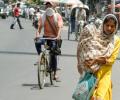
Uttar Pradesh is experiencing an intense heatwave, with Banda recording the highest temperature at 47.6 degrees Celsius. The IMD has issued a 'Red Colour Warning' for severe heatwave conditions. The extreme heat is disrupting daily life and economic activity, prompting government action to prevent heat-related illnesses.
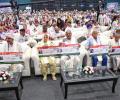
The government aims to cover around 60 million people in the age category, irrespective of income, with an assured 5 lakh annually to be shared within the family.

Haryana Chief Minister Nayab Singh Saini has launched development projects worth 253 crore in Jind district, focusing on irrigation, infrastructure, health, and water supply.

The government on Sunday gave a strong push to upgradation and expansion of healthcare infrastructure, medical education and pharma sector with the Union Budget 2026-27 announcing a slew of steps, including those aimed at making India a global hub for allied healthcare professionals and biopharma manufacturing.

Three laws passed in Parliament could boost central revenues, reshape GST cess flows, shift MGNREGA costs to states and create new budget headroom ahead of the 2026-2027 Union Budget, points out A K Bhattacharya.

The Union Budget for 2026-27, presented by Finance Minister (FM) Nirmala Sitharaman on Sunday, which was a first, had an excellent domestic macro backdrop. According to the first advance estimates, gross domestic product (GDP) in constant prices is projected to grow 7.4 per cent in the current financial year, against 6.5 per cent in 2024-25.
The implementation of the policy would require public health spending to rise to nearly 2.5 per cent of the gross domestic product, from the present dismal one per cent, with the Centre bearing about 40 per cent of it.
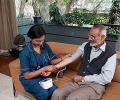
The share of total health expenditure as part of the gross domestic product (GDP) went down to 3.3 per cent in 2017-18 from 3.8 per cent in the previous two years, according to the national health account data released on Monday by the health ministry. The share of government expenditure as part of total expenditure as well as GDP has gone up from from 3.78 per cent to 5.12 per cent between 2013-14 and 2017-18, which could also explain a decline seen in out of pocket expenditure in 2017-18. Health ministry also emphasised the increase in the government health expenditure as part of the total GDP from 1.15 per cent in 2013-14 to 1.35 per cent in 2017-18.

'At COP30, the emphasis will be on unlocking climate finance, reinforcing the principle of common but differentiated responsibilities, and building resilience through inclusive transitions and the mainstreaming of adaptation.'
If he cannot do it this term by using his bureaucracy and experts from different fields, it will be a tragedy, asserts Ramesh Menon.
'The first duty of the government is to learn lessons from a bad experience and course correct. It's a pity that the government is making policy without looking at evidence and differentiating between immediate and urgent.'

The Union health ministry is releasing funds for states and Union territories under the National Health Mission for implementation of phase 1 up to June 2020.

'The Bhashini Mission has delivered a working technology at large scale, which is as good as or better than the one with MNC tech giants.'
The era where nations thrived through rigid alignments is giving way to an age where the connective State defines power. For India, that era has arrived, points out Dr Nishakant Ojha.
The World Bank has approved loans totalling $1.75 billion (about Rs 13,834.54 crore) to fund India's PM Ayushman Bharat scheme and private investment to boost the economic growth. Of the total loan, $1 billion will go towards the health sector, while the rest $750 million will be in the form of development policy loan (DPL) to fill the financing gaps through private sector investment in the economy. The World Bank Board of Executive Directors approved two complementary loans of $500 million each to support and enhance India's health sector.

The National Security Strategy document should flag all major issues concerning security strategy and provide guidelines to concerned departments to work out suitable action plans. Since the global and regional geopolitical canvas is dynamic, the NSS document should be deliberated at length before formulation and should be reviewed periodically, recommends Commodore Venugopal Menon (retd).

'Healthcare is not an industry.' 'The government is only encouraging insurance as they are not able to provide healthcare to people.' 'Opening new medical colleges is not what is needed.' 'You have to invest in public sector hospitals.' 'You cannot hand over healthcare to the private industry.'
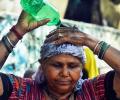
With the summer approaching sooner than scheduled, Maharashtra, Telangana, Odisha, and West Bengal have already started experiencing heat waves with temperatures soaring above 40°C.
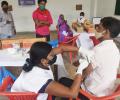
Rai said as informed by the health ministry, the central government has been providing required technical and financial assistance to all states and Union Territories (UTs) for strengthening their healthcare system, including management of the COVID-19 public health challenge, from time to time, and the financial assistance to states and UTs is provided under the National Health Mission (NHM).
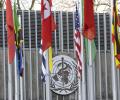
'Both international cooperation and self-reliance will now acquire new purpose.'

In view of Omicron variant of COVID-19, the Centre on Friday urged the private health sector to be ready as it has to play an important role in managing the pandemic.
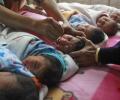
Kiran Mazumdar-Shaw points out how the adoption of information and communication technologies can provide India with a very effective health care tool.
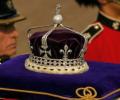
The United Kingdom extracted USD 64.82 trillion from India over a century of colonialism between 1765 and 1900 and USD 33.8 trillion of this went to the richest 10 per cent -- enough money to carpet London in notes of 50 British pound almost four times over.

During the session, General Dwivedi was asked about the overall challenges for the India Army going forward and learning from the border row in eastern Ladakh.
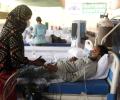
The Indian Council of Medical Research is conducting three different studies to ascertain the facts regarding rising cases of cardiac arrest after the pandemic, Mandaviya said in response to a question in the Lok Sabha.

Prime Minister Narendra Modi on Tuesday said the establishment of the WHO Global Centre for Traditional Medicine (WHO GCTM) in Jamnagar will usher in a new era of traditional medicine globally.

There could be a paucity of isolation and ICU beds, and ventilators, according to a study.

About 50 countries, including Canada, Mexico, Nigeria and Panama, have shown interest in having a Co-WIN like system to run their vaccination drive, a senior official said on Monday, adding India is ready to share the open source software free of cost.
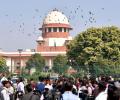
In an affidavit filed in the top court, the health ministry told the apex court that the family welfare programme in the country is voluntary in nature, which enables couples to decide the size of their family and adopt family planning methods best suited to them, according to their choice and without any compulsion.

If the BJP has to work as a junior partner of Vijay's TVK, then either the party will have to change the state leader, or the latter should change himself. Incidentally, ever since Vijay started talking politics and elections, the pro-BJP/Hindutva social media had stopped dragging his name into any non-existing issue.' In particular, they have stopped referring to him by his Christian name, 'Joseph Vijay', observes N Sathiya Moorthy.
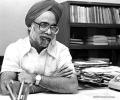
What stood out in his 15-year journey as a member of the political executive at the Centre was his glowing record as India's most successful and effective finance minister. Both as prime minister and finance minister, he understood the importance of gradualism, except when the economy or the polity was in a crisis.

'We have the technical expertise, and international collaborations. We also have robust real-time data. We are a university of pandemic management. If the ministry neglects the role of NCDC, it is the loss of the country'
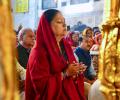
The scarcity of resources is particularly evident in the case of Rajasthan compared to many other states.
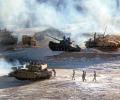
India's national security strategy needs to be revised periodically since the global and regional geopolitical situation is dynamic, points out Commodore Venugopal Menon (retd).

'Health will continue to be at the centre of the government's attention as it underpins economic recovery and our collective well being.'

With these states imposing lockdowns anew, the health ministry emphasised that the restrictions should be utilised to focus on containment, surveillance and testing in the containment and buffer zones as the key strategy for early detection of cases and fatality management.
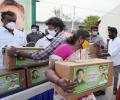
'Despite expanded testing the incidence remains low.' 'Therefore, the focus should be on specific districts where we need to improve the testing.' 'We should have a district-centric strategy.'

'You cannot fight a disease as complex as COVID-19 without a carefully calibrated, localised response.'

'We cannot be naughty and expect the government to do good!' 'We have to behave ourselves and then we can expect the government to support us.' 'If we are able to protect ourselves well, then we should not be having deaths.' 'Unfortunately, people have gotten into this super scary event participation (mode) -- birthday parties, large gatherings.' 'Among the people who have attended those, 80 to 90 per cent of them have come down with COVID-19.'
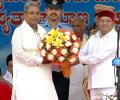
Why did Karnataka's economic prosperity fail to influence the nature of electoral promises made by political parties in the run-up to the assembly elections? asks A K Bhattacharya.
 © 2026 Rediff.com - Advertise with us - Disclaimer - Privacy Policy - Sitemap - Feedback - About us - Terms of use - Grievances